

Transcript
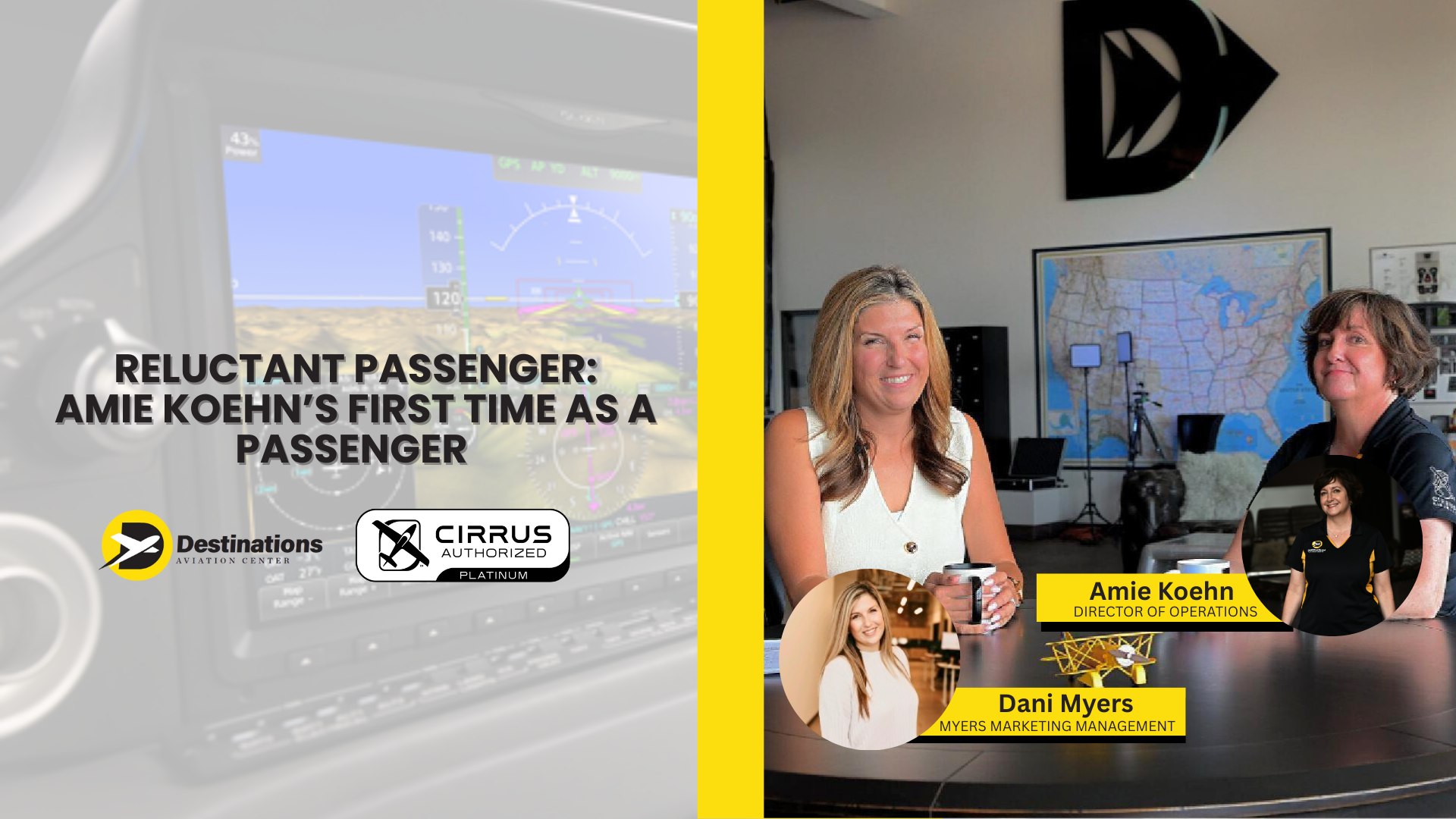
Dani: Hi, I’m Dani Myers.
Amie: And I’m Amie Kohen.
Dani: We’re here at Destinations Aviation in Tulsa, Oklahoma, and we’re just two gals here to talk about flying. We’re glad you’re here.
Dani: So Amie, we’re inside Destinations Aviation—more specifically, the clubhouse. The club room.
Amie: The club room.
Dani: And also an event center. Can you tell me a little bit about the event center?
Amie: Sure. My husband David founded Destinations Aviation, and he’s a music lover. Several of the people who work here are too. We wanted to create a vibe that supports flying and flight training, but also incorporates music into the atmosphere.
Amie: So rather than storing airplanes in our hangar, we converted it into an event center.
Dani: Yes. And that event center is called the Delta Echo Club.
Amie: The Delta Echo Club.
Dani: Now this is the club room.
Amie: And this is where all the fun happens.
Dani: I think the pilots would say the fun happens out there.
Amie: But there’s a lot of fun that happens in here too. Little parties, and just a relaxing area for club members to come work or hang out when they’re here in Tulsa.
Dani: So I have to ask you—are you a pilot?
Amie: I am not a pilot. And I don’t want to be a pilot.
Dani: Me neither.
Dani: The fun way that Amie and I connected is through business. We were working together on some projects, and my husband and I were talking about him getting his pilot’s license. Before I knew she wasn’t a pilot, I laughed and said, “Amie, I don’t even drive anywhere anymore.”
Dani: I’ve got three kids, we’ve been married a long time, and I’ve just gotten to a point where I’m completely okay being a passenger princess. I drive myself to work, but that’s about it.
Dani: And it came out that she had a similar story in the aviation world—that she doesn’t have her pilot’s license either.
Dani: Over the last few months, we’ve realized this is more common than not.
Dani: I’m new to being the wife of someone training to be a pilot. You’ve had quite a few years. How long has David been a pilot?
Amie: Thirty-five years.
Dani: Thirty-five years as a pilot. And now at Destinations Aviation, they offer Cirrus training—a very well-known training facility.
Dani: But that wasn’t always the case. Your first flight wasn’t in a Cirrus.
Amie: No. My first flight was in a Cessna 152, which is a very small aircraft.
Amie: David had just gotten his private pilot’s license. I was excited—we were going to get to go places instead of driving everywhere.
Amie: Even though I had flown commercial before, I had never been in a small plane. I had helped him study, so I was familiar with it, but I had never experienced it.
Amie: Our first flight was going to be three and a half hours in that plane.
Amie: We got in, and we were shoulder to shoulder. It’s loud. It’s small. You feel every bump.
Amie: After a while, my arms started hurting. I realized I was gripping the seat like I was holding the plane up underneath us.
Dani: You were white-knuckling it.
Amie: Absolutely. I didn’t even think I’d get nervous, but I was really nervous.
Amie: At one point, everything is going fine, and David takes his hands off the controls and starts digging in his flight bag.
Amie: My only frame of reference is driving—you don’t take your hands off the wheel.
Amie: So I freak out. “What are you doing?”
Amie: And he says, “If you’re nervous, just take the controls.”
Amie: I said, “You’re the effing pilot. You take the effing controls.”
Dani: That got things back on track.
Dani: That sounds like a story a lot of people can relate to.
Dani: My first flight was in a Cirrus with you. That’s where this conversation really started.
Dani: You gave me simple tips—nothing major—but they made a huge difference. We were flying to a fundraiser, about a 20–30 minute flight.
Dani: It was smooth takeoff, smooth landing, and a pilot with 35 years of experience helps.
Dani: So let’s create more experiences like that.
Dani: For non-pilots or spouses of pilots, what are some tips?
Amie: First, get familiar with the airplane. Sit in it, get comfortable.
Amie: Second, expect bumps. There will be turbulence.
Amie: If you’ve been on a boat, it’s just like waves. You just can’t see them.
Dani: That analogy was the thing that helped me the most. We spend time on the lake, so having that physical reference changed everything.
Amie: Turbulence is just part of the ride. It’s normal.
Amie: I’d also recommend keeping your first flight short—20 to 30 minutes—and go somewhere fun.
Amie: For me, I don’t fly because I love flying. I fly because I like getting places faster.
Dani: And there are great places to go. A lot of members here use planes to go to football games—OU, OSU, Arkansas, Texas.
Dani: It’s about staying connected.
Dani: One of the reasons we started looking into flying is our daughter is about to graduate and wants to go out of state. We want to be able to get to her easily.
Amie: A lot of people here use it the same way—visiting kids, running businesses across regions, saving time.
Dani: Six-hour drive or a couple-hour flight.
Amie: Time over money.
Dani: Exactly.
Dani: And with all those pilots, there are always passengers who have never flown before.
Dani: It’s normal to be nervous. It’s unfamiliar, and it can feel intimidating.
Amie: But it’s actually very safe—especially in a Cirrus.
Dani: I’ll admit, I was spoiled. My first flight had the parachute system, and that gave me peace of mind.
Dani: Also, flying with the instructors my husband trains with helped me understand what he’s learning.
Dani: If you have that opportunity, I highly recommend it.
Amie: Communication helps too. Over time, David got really good at explaining everything—how long the flight is, what the weather will be like, what he’s doing in the air.
Amie: Overcommunication makes a huge difference.
Dani: We should probably have him do a video on how to keep passengers calm.
Amie: I think people would love that.
Dani: We hope this helps as you go into your first flights or even consider becoming a pilot.
Dani: If you have questions, call up here. It’s very accessible, and they’ll even come to you and help you get familiar with aviation.
Dani: Thank you guys. We’ll be back with more tips—and maybe we’ll bring David in next time.
Amie: Mhmm.
Why Flying in a Small Plane Feels So Different and How to Get Comfortable Faster
For most people, flying in a small airplane doesn’t start with excitement. It usually starts with hesitation.
It is not necessarily because people think it is unsafe. It is because it is unfamiliar in a very specific way. The sounds are different. The movement feels different. The space is tighter. And for a lot of people, it is the first time they have been in an environment where they do not understand what is normal.
That alone is enough to create tension.
What is interesting, though, is that the discomfort people feel is rarely about flying itself. It is about how the experience is interpreted in the moment.
Once that changes, everything starts to feel more manageable.
The Real Issue Is Not Flying, It Is Control
Most first-time passengers are not afraid of the airplane. They are uncomfortable with the lack of control.
When you are in a car, you understand what is happening even if you are not driving. You know what acceleration feels like. You know what braking feels like. You know what a turn is supposed to feel like.
You have years of built-in experience to rely on.
In a small aircraft, that disappears. A slight climb can feel exaggerated. A gentle turn can feel sharper than expected. Even small bumps can feel more intense.
Nothing about those sensations is actually unusual. They just feel that way because your brain has nothing to compare them to.
When people cannot explain what they are feeling, they tend to assume something is wrong. That is where most of the anxiety comes from.
Why a Simple Comparison Can Change Everything
One of the most helpful ways to make flying feel more normal is to compare it to something familiar.
The best example is water.
If you have ever been on a boat, you already understand how movement works in a fluid environment. The surface is not perfectly still. There are waves, wakes, and changes that you cannot always predict, but you trust that the boat is built to handle it.
Air works in a similar way. You are moving through currents that you cannot see.
That small shift in thinking can make a big difference. Instead of reacting to every movement, you start to recognize it as part of the environment.
It does not mean you suddenly love turbulence. It just means you understand it.
The First Flight Matters More Than People Think
There is a practical side to this that often gets overlooked.
Your first flight sets the tone for everything that comes after.
If it is long, uncomfortable, or confusing, it can reinforce the idea that flying is something to endure.
If it is short, smooth, and explained well, it builds confidence quickly.
That is why shorter first flights tend to work better. Twenty to thirty minutes is enough time to experience takeoff, cruising, and landing without letting anxiety build too much.
It also helps if there is a purpose behind the flight. Going somewhere, even for something simple, makes the experience feel more natural.
You are not just flying for the sake of flying. You are getting somewhere.
Good Communication Changes the Experience
One thing that separates a stressful flight from a comfortable one is communication.
When passengers do not know what is happening, they try to interpret it themselves. That is usually where things start to feel worse than they are.
A small change in engine sound, a turn that was not expected, or a bump in the air can feel significant if there is no explanation.
On the other hand, when a pilot talks through what is happening, it removes the guesswork.
Simple comments go a long way. Letting someone know that a climb is coming, or that the air might get a little bumpy for a minute, keeps everything in context.
It does not take much. It just takes awareness.
Getting Used to It Happens Faster Than You Think
Most people assume that flying in a small plane is something you either tolerate or you do not.
In reality, it is something you get used to.
The first time can feel intense. The second time feels more manageable. After a few flights, your brain starts to recognize the patterns.
This is how people adjust to anything unfamiliar. Aviation is no different.
The key is not to avoid the experience. It is to approach it in a way that allows your comfort level to build over time.
Not Everyone Flies Because They Love It
There is a common idea that people who get into aviation are doing it because they are passionate about flying.
That is true for some, but not for most.
A lot of people fly because it is practical.
It saves time. It makes travel easier. It allows people to show up where they need to be without spending hours on the road or working around commercial flight schedules.
For families, it can mean staying connected even when people move out of state. For business owners, it can mean managing multiple locations more efficiently.
The airplane is not the goal. It is a tool that changes what is possible.
The Environment Around the Experience Matters
Something else that plays a role is how people are introduced to aviation.
If the first experience feels technical or overwhelming, it reinforces the idea that this is something complicated.
If it feels relaxed and approachable, it becomes easier to step into.
People do not need to understand everything about flying to feel comfortable with it. They just need to feel like they are allowed to learn at their own pace.
That is what lowers the barrier.
A Little Understanding Goes a Long Way
Confidence in flying does not come from knowing everything. It comes from knowing enough.
You do not need to understand how the aircraft works in detail. You do not need to know every system or procedure.
You just need to recognize what is normal.
Once you can do that, the experience changes. It stops feeling unpredictable and starts feeling structured.
That shift is what allows people to relax.
What Most People Realize After Their First Flight
A lot of people walk into their first flight expecting it to feel overwhelming the entire time.
What usually happens is a little different.
The beginning feels unfamiliar. There is some tension during takeoff. There might be moments during the flight that feel uncertain.
But at some point, things level out. The movement becomes more predictable. The environment starts to feel less foreign.
By the time the flight is over, most people are not thinking about how uncomfortable it was. They are thinking about how different it was from what they expected.
That difference is what opens the door to doing it again.
Final Thought
Flying in a small aircraft is never going to feel exactly like driving a car.
It is a different experience with different sensations and a different perspective.
But different does not have to mean uncomfortable.
With the right expectations and a little bit of context, it becomes something that people can get used to much faster than they think.
Not because the experience changed, but because they did.